Most of what we export never started as a product. It started as something a farm or a food processor needed to get rid of. Coconut shell, rice husk and cinnamon offcuts are by-products of Sri Lanka's biggest agricultural exports — and turning them into something international buyers want is, in a very literal sense, our whole business.
Where The Raw Material Comes From
We don't grow coconuts, rice or cinnamon ourselves. We work with a network of processors and estates across Sri Lanka who already generate these by-products as a matter of course — desiccated coconut factories discarding shell, rice mills discarding husk, cinnamon peelers discarding bark and offcuts. As a raw coconut shell charcoal supplier and coconut shell charcoal exporter Sri Lanka buyers already work with, our first job is simply collection and consistent quality sorting before anything reaches a kiln.
Inside The Kiln — Carbonization Without Chemicals
Carbonization is a controlled, low-oxygen burn that drives off moisture and volatile compounds, leaving behind stable, high-carbon material. No activation chemicals, no synthetic binders. We monitor kiln temperature and burn duration closely, because that's what actually determines the burn time and ash content our buyers see on the finished spec sheet — get it wrong and you either under-carbonize (inconsistent burn) or over-carbonize (excess ash, wasted yield). Every batch that comes out of our kilns as crushed coconut shell supplier export or briquetted charcoal is tested before it's cleared for packing.
From Rice Husk To Biochar
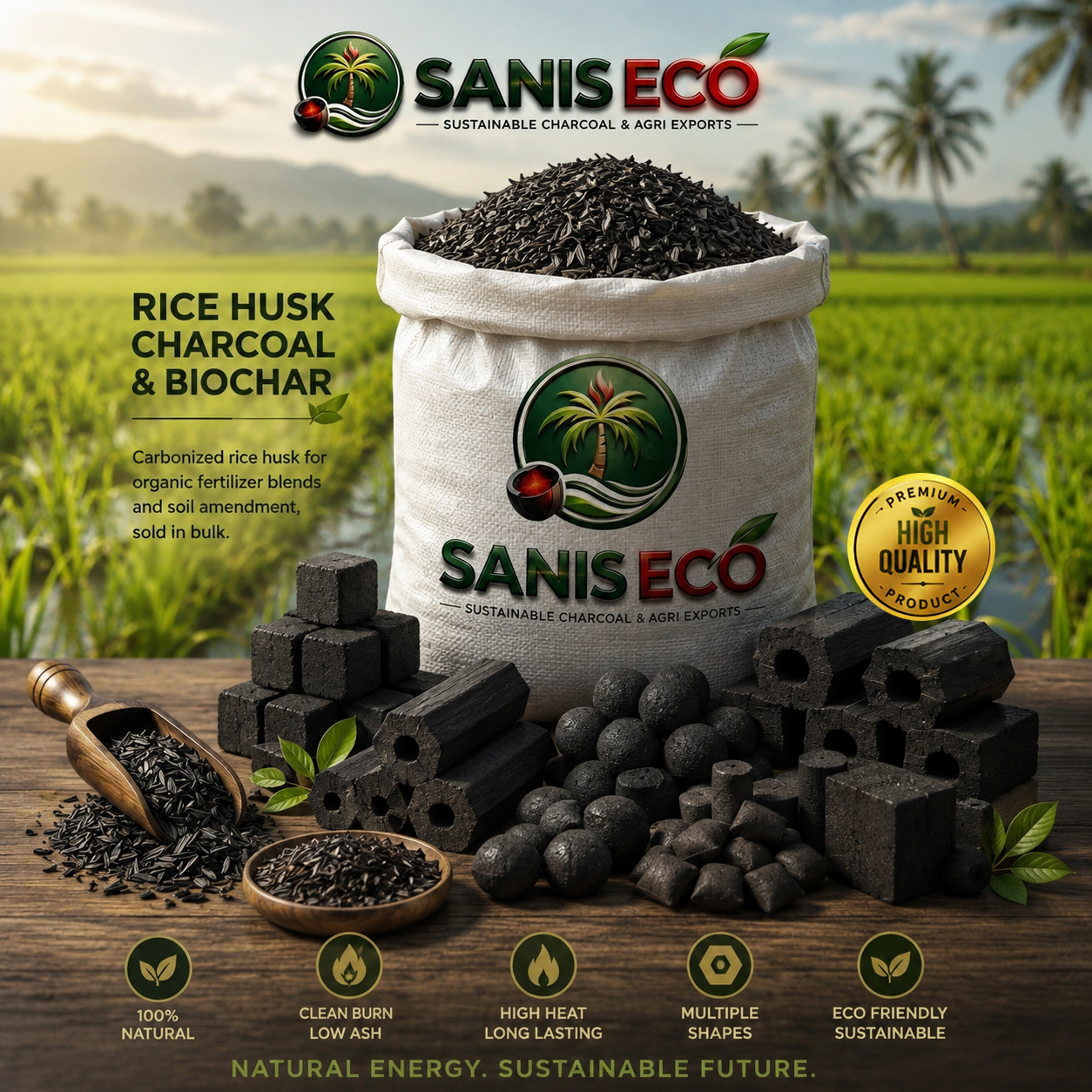
Rice husk gets a slightly different treatment. Rather than briquetting it for fuel, most of our rice husk charcoal supplier output is carbonized into biochar — a porous, carbon-rich material agricultural buyers blend into soil to improve water retention and nutrient uptake. We ship this as rice husk biochar export bulk to fertilizer blenders and as rice husk charcoal for organic fertilizer to agricultural distributors building their own soil-amendment product lines.
"Every product line starts as agricultural by-product that would otherwise be discarded — nothing we ship began its life intended for export." — Sanis Eco Export Desk
Cinnamon Offcuts Get The Same Treatment
Sri Lanka is the world's largest producer of true (Ceylon) cinnamon, and the peeling and processing side of that industry generates a steady volume of wood offcuts. We carbonize these into aromatic lump and briquette charcoal, sold as ceylon cinnamon wood charcoal export — a genuinely single-origin product that most other charcoal exporters, working purely with coconut shell, simply can't offer.
The Numbers Behind One Container
To put the scale in perspective, a single 20ft container of charcoal represents multiple tonnes of raw shell, husk or wood that would otherwise be burned in open piles or left to decompose uncontrolled — both of which release the same carbon with none of the economic value captured. And the loop doesn't end at charcoal: ash and processing residue from our operations feeds into our organic compost fertilizer exporter Sri Lanka line, so as little as possible leaves the process as true waste.